
When a Jacksonville tenant was charged a $250 “administrative fee” after moving out, it looked like a routine move-out charge. It wasn’t. That fee became the center of a class action that ultimately delivered relief to nearly 1,900 Florida tenants and left a lasting mark on the community it was meant to protect.
The Case
In Latasha Burns v. Sun Coast Property Management, LLC (Case No. 16-2021-CA-006059, 4th Judicial Circuit, Duval County), Story Law Group alleged that Sun Coast Property Management charged tenants a $250 Administrative Fee whenever it assessed move-out damages over $500 — a fee the lawsuit argued had no connection to any actual cost or service, in violation of the Florida Residential Landlord Tenant Act (Fla. Stat. § 83.40) and the Florida Consumer Collections Practices Act (Fla. Stat. § 559.55 et seq.).
The Settlement
On September 23, 2025, the Honorable Virginia Norton of the 4th Judicial Circuit granted final approval, finding the settlement fair, reasonable, and adequate under the Bennett factors. The relief included:
- $250 debt waiver per leased unit for tenants who were charged but hadn’t yet paid the fee
- $200 settlement payment per unit for tenants who had already paid it
- An additional $100 in statutory damages per unit for tenants in the FCCPA subclass
- Forgiveness of the fee going forward for current tenants, an estimated $196,250 benefit
- A $10,000 incentive award to named plaintiff Latasha Burns for her role representing the class
In total, the settlement delivered $765,850 in relief to Jacksonville-area tenants — without a single class member needing to opt in, file a claim form, or hire a lawyer of their own.
Directing the Residual Funds to Jacksonville Area Legal Aid
Under the doctrine of cy pres — French for “as near as possible” — courts can direct unclaimed class action funds toward an organization that serves the same population the class was meant to protect, rather than letting the money revert to the company that violated the law in the first place.
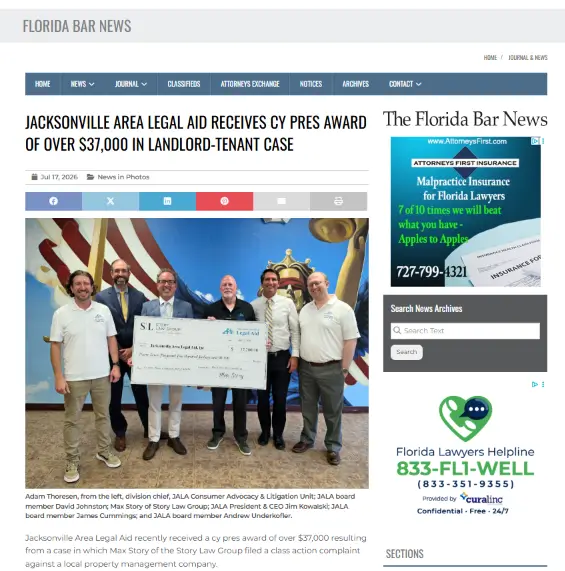
Judge Norton approved Jacksonville Area Legal Aid (JALA) as the cy pres recipient. JALA received $37,200 in unclaimed residual funds from the settlement earlier this year, followed by a final disbursement of $22,420 — bringing the total cy pres award to $59,620, money JALA plans to use to continue helping tenants facing unlawful fees and charges of their own.
“Given all the work JALA does to protect the rights of tenants, it seemed it would be the most appropriate beneficiary of the residuals in this case,” attorney Max Story said, noting JALA’s nationally recognized housing and consumer unit was uniquely positioned to serve people like the tenants in this class.
Why This Matters
Cases like this one are a reminder that even a “small” fee — one that might not seem worth fighting on its own — can violate tenant protection and debt collection laws, and can add up to real money when it’s charged across an entire portfolio of rental units. If it happens to one tenant, it’s usually happening to hundreds or thousands more.
If you were charged a move-out fee, administrative fee, or other unexplained charge by a Florida property manager, you may have rights under the FRLTA or FCCPA — even if the amount seems too small to fight alone. Story Law Group represents tenants and consumers on a contingency basis, with no upfront cost to you.
About the Author
Max Story, Esq.
Max Story, Esq. is a consumer protection attorney representing clients in matters involving unauthorized bank transfers, Zelle fraud, EFTA claims, Regulation E violations, and other banking disputes. He helps consumers protect their rights when financial institutions fail to comply with federal law and works to recover funds lost through unauthorized electronic transactions.
Contact Story Law Group for a free case review
Story Law Group represents consumers throughout Florida in FCRA, FCCPA, FRLTA, and related consumer protection matters, and works on a contingency fee basis — clients are never billed directly for the firm’s work.